
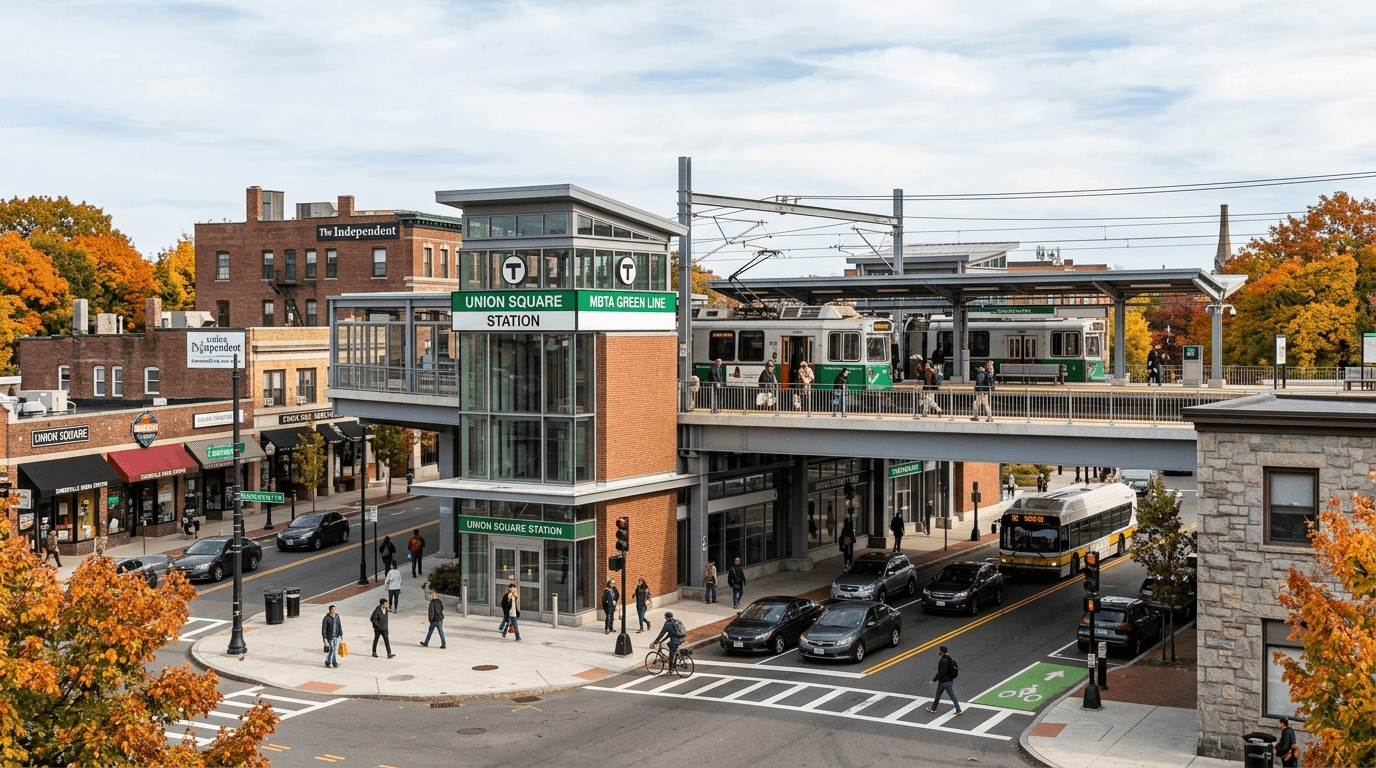
# How Your 2026 Property Tax Bill Could Shift After Somerville's Latest Assessment: A Homeowner's Framework
Key Takeaways
•The bottom line: A citywide assessment shift does not hit every homeowner equally. Your 2026 property tax bill depends on YOUR parcel and the new development near you — not a single citywide number.
•The driver to watch: The Green Line Extension corridor (Union Square Somerville, North Point Somerville, Assembly) is likely resetting local sale prices. In many cycles, that can pull nearby assessments higher than in older neighborhoods like Davis Square — though this is a tendency, not a guarantee, and an established area can sometimes outpace a new-build corridor.
•The math you need: Your bill change ≈ (the dollar change in your assessed value ÷ 1,000) × the certified mill rate, minus any exemptions you qualify for.
•The honest caveat: This guide gives you the framework and the math. To finish the calculation, you need two inputs from the city: your own parcel's assessed values and Somerville's certified FY2026 mill rate. We explain exactly where to find both.
Why Aren't Your North Point Neighbor and Your Davis Square Cousin in the Same Boat?
Most Somerville homeowners hear "revaluation" and picture a uniform tax bump landing on every doorstep at once.
That is not how it works.
The FY2025–FY2026 revaluation lands differently across the city. Some blocks may barely move. Others may see a sharper jump.
Two homeowners can share a ZIP code and still get very different 2026 property tax bills. Where you sit relative to new development is the variable that decides it.
As of June 22, 2026, FY2026 bills are being finalized. The market impact of the Green Line Extension is still working its way through local values.
Your tax bill is not based on a citywide average. It is based on your parcel, your assessed value, and the tax rate Somerville certifies.
Two quick definitions worth anchoring to:
•Assessed value — the city's tax estimate of your home.
•Mill rate — the tax rate per $1,000 of assessed value.
Key Takeaway: Same city, same revaluation, different outcomes. Your block's recent sales drive your number.
What Is the 60-Second Takeaway for Busy Homeowners?
Assessment increases tend to cluster near new development — and in Somerville, the Green Line Extension fundamentally redrew the value map. Areas near new stations, condo buildings, and large apartment projects face stronger assessment pressure than neighborhoods where the built environment has stayed relatively stable.
Your tax bill change comes down to three levers:
1. Your assessed-value change — how much the city's estimate of your home moved.
2. The mill rate — the per-$1,000 tax rate the city certifies.
3. Your exemptions — the residential exemption for owner-occupants is the big one. CPA (Community Preservation Act) and veteran exemptions can also apply.
The formula every owner needs:
Change in Tax ($) = (dollar change in assessed value ÷ 1,000) × mill rate
If your assessment rises more than your neighbor's, your bill can rise more too — even if you live only a few blocks apart. Parcels near new Green Line stations and recent construction can set higher local sale prices, which become the comparison points the city uses. Those comparisons, in turn, lift nearby assessments.
Key Takeaway: Three levers, one formula. Everything below is just applying it to your home.
How Did Somerville Get Here?
Ten years ago, Union Square, East Somerville, and the North Point/Assembly corridor looked very different from today. Transit access was weaker. Large-scale development was limited. Then the Green Line Extension changed the map.
New apartment and condo buildings clustered near the corridor. Each sale helped set a new local benchmark, and assessments followed those sales upward over time.
Davis Square followed a different path. It was already one of Somerville's premium areas, with older housing stock — including triple-deckers — and far fewer brand-new buildings. Prices still rose, but with less dramatic revaluation pressure.
That is why FY2026 matters. The gap between fast-changing corridor areas and older, more established neighborhoods may now feel more visible in tax bills.
Key Takeaway: New buildings reset nearby comparisons. Older, build-light neighborhoods typically move more gradually.
How Should You Compare Davis Square, Union Square, and North Point?
There is no shortcut that skips your own parcel. But you can build useful context with a simple, repeatable framework. For any neighborhood you want to understand, gather three things:
1. The median assessed-value change, in percent and dollars.
2. The median dollar change in the tax bill.
3. The reason the number moved — for example, a cluster of new sales.
To fill in that framework with real figures, you need the City Assessor's parcel export — the official record of assessed values block by block. That parcel-level file is the only source that can populate these columns accurately, and it is the same file you will use for your own home.
Treat the neighborhood comparison as a working worksheet, not a finished table. Pull the parcel data for the areas you care about, drop the numbers into the three columns above, and the pattern for each neighborhood will emerge from actual records rather than from estimates.
The important point: do not chase a single citywide average. A citywide median blends every neighborhood together and tells you almost nothing about your block. A neighborhood median is a better lens, but it is still an average — condos, single-families, triple-deckers, and multifamily homes all sit inside that one number. Use the neighborhood figure for direction, then drill down to your individual parcel for the real answer.
If you own near North Point, Union Square Somerville, or another GLX-adjacent area, your assessment may be shaped by newer sales and nearby development. If you own in Davis Square, your change may reflect a more mature market with fewer new-build comparisons.
Either way, your parcel still decides the bill.
Key Takeaway: Use the neighborhood structure for context. Use your own parcel record for the real answer.
How Do You Turn an Assessment Change Into an Actual Tax Bill Estimate?
Here is the step-by-step math for your own home.
•Step 1 — Find your values. Pull your prior and current assessed values from the City Assessor's online parcel lookup.
•Step 2 — Do the subtraction. Dollar change = current assessed value minus prior assessed value.
•Step 3 — Find the percent change. Percent change = 100 × the dollar change ÷ prior assessed value.
•Step 4 — Apply the formula. Change in Tax = dollar change ÷ 1,000 × the certified mill rate.
•Step 5 — Subtract exemptions. If you live in the home, confirm the residential exemption is applied. Veteran and CPA exemptions may also apply.
Worked example (illustration only — not Somerville's actual figures):
Suppose a homeowner's assessed value rises $48,000.
For this illustration, assume a mill rate of 14.62. This is a placeholder number only — it is not Somerville's certified FY2026 rate, so do not use it for a real estimate. Substitute the certified rate the city publishes.
($48,000 ÷ 1,000) × 14.62 = $702 higher per year, before exemptions.
A $48,000 increase in assessed value works out to roughly $702 more per year in this example — before exemptions, and using the placeholder rate above.
One important distinction: assessed value is not the same as market value. Your final bill also depends on the city budget, the certified mill rate, and any exemptions on your account.
Key Takeaway: The formula gives you a strong estimate once you plug in the certified rate and your exemptions.
What Are the Strongest Arguments Against This Approach?
A good tax estimate should be honest about its limits. Here are the three biggest concerns — and how to think through each one.
Does a Bigger Assessment Always Mean the Same-Sized Bill Increase?
No.
This is where Massachusetts' Proposition 2½ matters. In plain terms, Proposition 2½ limits how much total property tax revenue a city can raise each year, with some exceptions. If assessed values rise across Somerville, the mill rate often adjusts downward — which can soften the impact on individual bills.
That has a direct consequence for the worked example above. In a broad revaluation year, the certified rate may land lower than the prior year's rate, meaning a static calculation can overstate the real bill increase. Always run the math with the new certified rate, not last year's.
This is also why a 10% assessment increase does not automatically mean a 10% tax bill increase. Use the dollar formula instead:
Change in Tax = (assessment increase ÷ 1,000) × mill rate
That gets you much closer to the actual impact on your wallet.
Can a Neighborhood Median Miss What Is Happening to Your Home?
Yes.
A neighborhood includes condos, single-families, triple-deckers, and multifamily homes. One median number cannot describe every property type within it. The neighborhood view is a useful direction-finder — it narrows the citywide noise down to your area — but your individual parcel is the only thing that produces your actual number. Your home may move more or less than the neighborhood median.
Could the Green Line Corridor Not Be the Steepest-Rising Area?
Yes — and precision matters here.
The corridor tends to rise faster under two specific conditions: when new, higher-priced sales are clustering near a station, and when those recent sales sit above the older assessed values nearby. When both conditions are present, corridor parcels usually face stronger upward pressure.
When they are absent — say, in a cycle where an established neighborhood like Davis Square sees its own surge of high-value sales — an older area can outpace a new-build corridor. The corridor effect is a conditional watch point, not a fixed ranking.
If you are near Union Square Somerville, North Point Somerville, Assembly, or any GLX station, check the recent sales around you. They may already be influencing your assessed value.
Key Takeaway: The method is sound. The specific neighborhood ranking depends on parcel-level assessment records and the sales conditions in a given cycle.
Who Should Be Extra Careful With the Citywide Average?
Some owners should be especially cautious before assuming a citywide number applies to their situation.
•Owner-occupants with the residential exemption may see a softer bill than investor-owned or absentee-owned properties.
•Owners near one major new project may see local numbers skewed by a tower, assemblage, or large condo building.
•Condo owners and triple-decker owners can see very different per-unit assessment changes.
•Recent buyers near a GLX station may already have their purchase price reflected in the new assessment.
•Owners with assessments above nearby sales should review whether an appeal makes sense.
If your assessment rose sharply but nearby comparable sales do not support it, that warrants a closer look. A simple question to ask yourself:
"Do the recent sales on my block actually support the city's new value?"
If the answer is no, you may have grounds to challenge the assessment.
Key Takeaway: Medians hide outliers. Check your own block before you accept the number.
What Does the Current Somerville Market Say About Assessments?
Your assessment is tied directly to the market around you.
Single-family homes are Somerville's highest-priced segment, with a median sold price of $1,558,000. Condos sit at $1,000,000. Mixed properties come in at $1,040,000.
Median Sold Price by Property Segment
Comparison of median sold prices across Somerville property segments over the last 180 days.
| Series | Label | Value |
|---|---|---|
| Median Sold Price | Single-Family | 1558000 |
| Median Sold Price | Condo | 1000000 |
| Median Sold Price | Mixed | 1040000 |
Source:Repliers / MLSPIN
Those sale prices matter because they become the comparison points used in future assessments.
Supply tells another part of the story. Condos show the deepest supply at 11.1 months of inventory — meaning it would take 11.1 months to sell every condo currently listed at today's pace. Single-family homes are tighter at 8.4 months.
Months of Inventory by Property Segment
Comparison of available supply measured in months of inventory across Somerville property segments over the last 180 days.
| Series | Label | Value |
|---|---|---|
| Months of Inventory | Single-Family | 8.4 |
| Months of Inventory | Condo | 11.1 |
| Months of Inventory | Mixed | 10.9 |
Source:Repliers / MLSPIN
Speed also differs by property type. Condos are moving fastest, with a median of 21 days on market. Single-family homes are taking 29 days.
Median Days on Market by Property Segment
Comparison of median days on market across Somerville property segments over the last 180 days.
| Series | Label | Value |
|---|---|---|
| Median DOM | Single-Family | 29 |
| Median DOM | Condo | 21 |
| Median DOM | Mixed | 22 |
Source:Repliers / MLSPIN
At first glance, the condo numbers look contradictory: the deepest supply (11.1 months) paired with the fastest sales (21 days). These two measures describe different things, so they can coexist. Days on market reflects how quickly an individual listing finds a buyer once it sells. Months of inventory reflects the total listed stock relative to the monthly sales pace. Condos carry a large standing pool of listings — new construction and resale units keep the total stock high — yet the individual units that do sell tend to move quickly. Plenty of choice on the shelf, but desirable units still clear fast.
The "so what" for your tax bill: the sales behind these numbers help shape assessed values. If your property type or block is selling quickly and at higher prices, your assessment may face more pressure.
Key Takeaway: Single-family stock is the priciest and tightest segment. Condos have the deepest supply but still sell quickly. These sales feed directly into assessments.
What Should You Check Before You Pay or Appeal Your FY2026 Bill?
Use this checklist now.
•☐ Pull your prior and current assessed values from the Somerville Assessor's online parcel database.
•☐ Calculate your dollar and percent assessment change.
•☐ Look up the certified FY2026 mill rate the city has published, then multiply dollar change ÷ 1,000 by that rate.
•☐ Confirm your residential exemption is applied if you live in the home.
•☐ Check whether any veteran or CPA exemptions apply.
•☐ Compare your new assessed value to recent sales on your block.
•☐ Look closely if you are near Union Square Somerville, North Point Somerville, Assembly, or a GLX station.
•☐ Flag the property for review if your assessment is far above nearby comparable sales.
This checklist turns a confusing tax notice into a manageable review. You are not trying to decode the whole city — you are trying to understand your one parcel.
What Comes Next for the Green Line Corridor?
GLX-adjacent development is still actively shaping Somerville. As more projects deliver near Union Square, North Point, Assembly, and other transit-connected areas, nearby assessments may continue to feel upward pressure.
That does not make those neighborhoods bad places to own. It means they move differently.
There is a real lifestyle choice embedded in the tax math. A slower, more established area like Davis Square carries different tax and value patterns than a faster-changing corridor like North Point or Union Square. Both can be smart long-term positions — the key is understanding which dynamic you are in.
The action step is the same for every Somerville homeowner. You can run the math yourself once you have the two city-published inputs: your parcel's assessed values and the certified FY2026 mill rate. The checklist above walks you through every step.
If you would rather not assemble those inputs alone, we can help. Send over your address and exemption status. We can pull the parcel records, apply the certified rate, and walk through the numbers with you block by block — including whether an appeal is worth pursuing.